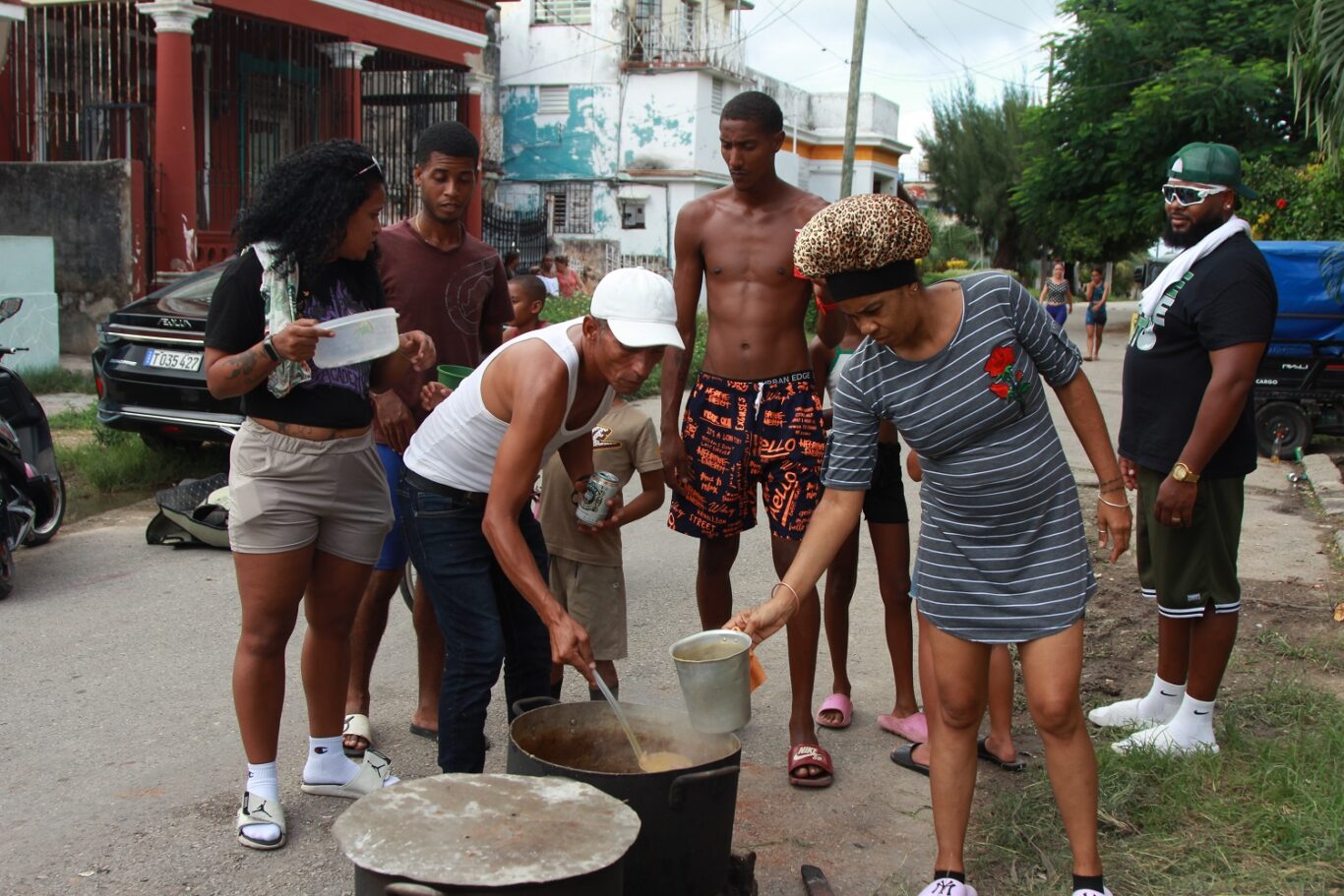
Neighbors share a collective stew in the Buenavista neighborhood of Havana during nationwide power outages. Photo credit: Frangel De la Torre Núñez, On Cuba News.
My Cuban American family in Tampa were among the three million Floridians who suffered power outages in the wake of Hurricane Milton. I had an opportunity to help as the only one among my family members to not lose power. “Time for some family bonding,” I told myself as I prepared to host several family members in my one-bedroom condominium.
Over the next several days, five to eight family members stayed with me at any given time. There was snoring, arguments, and lines for the bathroom, but also laughter, family stories, and a big pot of arroz con pollo that my mom prepared. The hum of my six-year-old niece’s nebulizer machine sounded faint compared to her tablet playing clips of Bluey at full volume. My ears were relieved to hear, “tio, do you want to play Uno again?”
On day three my mom asked me, “have we drove you crazy yet?” “No. Not yet,” I said with a wink. Not hesitating to help in times like this was how I was brought up. “Nuestra manera es la manera Cubana” my abuelo would say. Our way is the Cuban way.
While some family members had their power restored within three days, it took six days before my mom could get power back to her home. My mom did not complain. “It’s like a vacation compared to what they deal with in Cuba,” she told me.
I thought back to this time with my family as I listened to U.S. Press Secretary Karine Jean-Pierre being asked about Cuba’s recent island-wide power failures. The Press Secretary started by saying, “the U.S. is not to blame for the blackouts on the island or the overall energy situation in Cuba.” She emphasized that “the Cuban government has not requested any assistance” from the United States government. A journalist followed up by asking what the Biden-Harris administration would do if the Cuban government made a request for assistance. The Press Secretary replied that the Biden-Harris administration “certainly would assess the next best steps.”1
These comments struck me for a couple of reasons. First, the suggestion that the world’s most powerful country bears no responsibility for blackouts in an island nation after sanctioning it for 64 years feels detached from reality. After all, there is good reason why the United Nations General Assembly has voted 31 years in a row for the United States to end its economic blockade against Cuba.2
The second thing that struck me was the idea of withholding help until asked, even when you have the means to help and know full well that help is needed. Had I told my 85-year-old abuela, who left Cuba in 1969, that I had to “assess the next best steps” before housing her after her neighborhood lost power she might have told me, among other things, that I have been too Americanized. It certainly would not have been in line with the Cuban way in which I was raised.
The press secretary’s comments follow an all-too-common narrative in the United States. That is, that the Cuban government does not ask for or accept help because it is uninterested in supporting its own people. It is a harmful myth that distracts from the central role of the U.S. blockade in fueling Cuba’s power failures.
It is simply false that the Cuban government does not seek assistance for addressing issues on the island. Cuba has requested and accepted aid multiple times from the Biden-Harris administration. In October 2022, Cuba accepted $2 million in aid assistance from the United States after the devastation of Hurricane Ian.3 Two months earlier, a lightning strike sparked a massive fire at Cuba’s largest oil reserve center in Matanzas. Cuba requested help from the United States and several other countries. While Mexico and Venezuela sent material aid and teams of firefighters to Cuba, the United States only offered technical assistance over the phone. Cuba accepted the help offered by the United States and expressed gratitude all the same.4
Cuba has a strong record of diplomatic relations with other countries, and not just other U.S. adversaries like Venezuela, China, Russia, and Iran. Cuba has built strong ties with Mexico, Canada, Brazil, Japan, Turkey, Spain, Italy, Barbados, South Africa and many more. These relationships have allowed Cuba to receive aid as well as offer aid, such as when Cuban doctors went to Italy during the early stages of the COVID-19 pandemic.5
Ironically, there have been cases in which the United States has refused help from Cuba. For example, in 2005 after Hurricane Katrina made landfall, the Bush administration rejected Cuba’s offer to send field hospitals, tons of medical supplies, and over 1,500 doctors to help the people of Louisiana.6
Aid requests aside, is the call to end U.S. sanctions not an effort to alleviate Cuba’s energy crisis?
If Cuba had unrestricted access to the international market, completely unimpeded by U.S. coercion, its energy crisis could be addressed in a matter of months. Consider the fact that 18 days of the U.S. blockade costs as much as one year of maintenance for Cuba’s entire electrical power grid.7 The benefits would be amplified if the United States were to also remove its sanctions on Cuba’s trading partners with significant oil reserves like Venezuela, Russia, and Iran.
U.S.-based criticisms of any lack of formal aid requests by Cuba to the United States is like someone stepping on a person’s neck and chastising the victim for not asking their attacker for medical assistance. The clear solution is for the boot to be released first and foremost. Cubans are not helpless victims that need U.S. aid to survive. They simply need the U.S. to take its giant boot off their necks. Is that too much to ask for?
Just as I played Uno with my family in Tampa, Cubans have been playing dominoes while they wait for their power to return. Just as my mom cooked a big pot of arroz con pollo, neighborhoods in Cuba are cooking collective stews to keep themselves fed. Growing up I was taught this was the “Cuban way.” In my adulthood I have learned this is the human way.
As Cuban Americans, the best way we can help Cuba is to unite in calling for the end of the U.S. blockade. It’s not just the Cuban way, it’s the human way.
References:
- https://www.whitehouse.gov/briefing-room/press-briefings/2024/10/21/press-briefing-by-press-secretary-karine-jean-pierre-october-21-2024/
- https://press.un.org/en/2023/ga12554.doc.htm
- https://www.state.gov/u-s-support-for-hurricane-ian-recovery-efforts-in-cuba/
- https://www.reuters.com/world/americas/major-fire-spreads-cuban-fuel-storage-facility-hit-by-lightning-2022-08-06/
- https://theconversation.com/by-sending-doctors-to-italy-cuba-continues-its-long-campaign-of-medical-diplomacy-134429
- https://www.nbcnews.com/id/wbna9311876
- https://nnoc.org/wp-content/uploads/2024/09/InformeB2024En.pdf
 Cuban-Americans for Cuba